
Central Operations
Combined Copper Mines in Central Namibia
Central Operations: Otjihase & Matchless
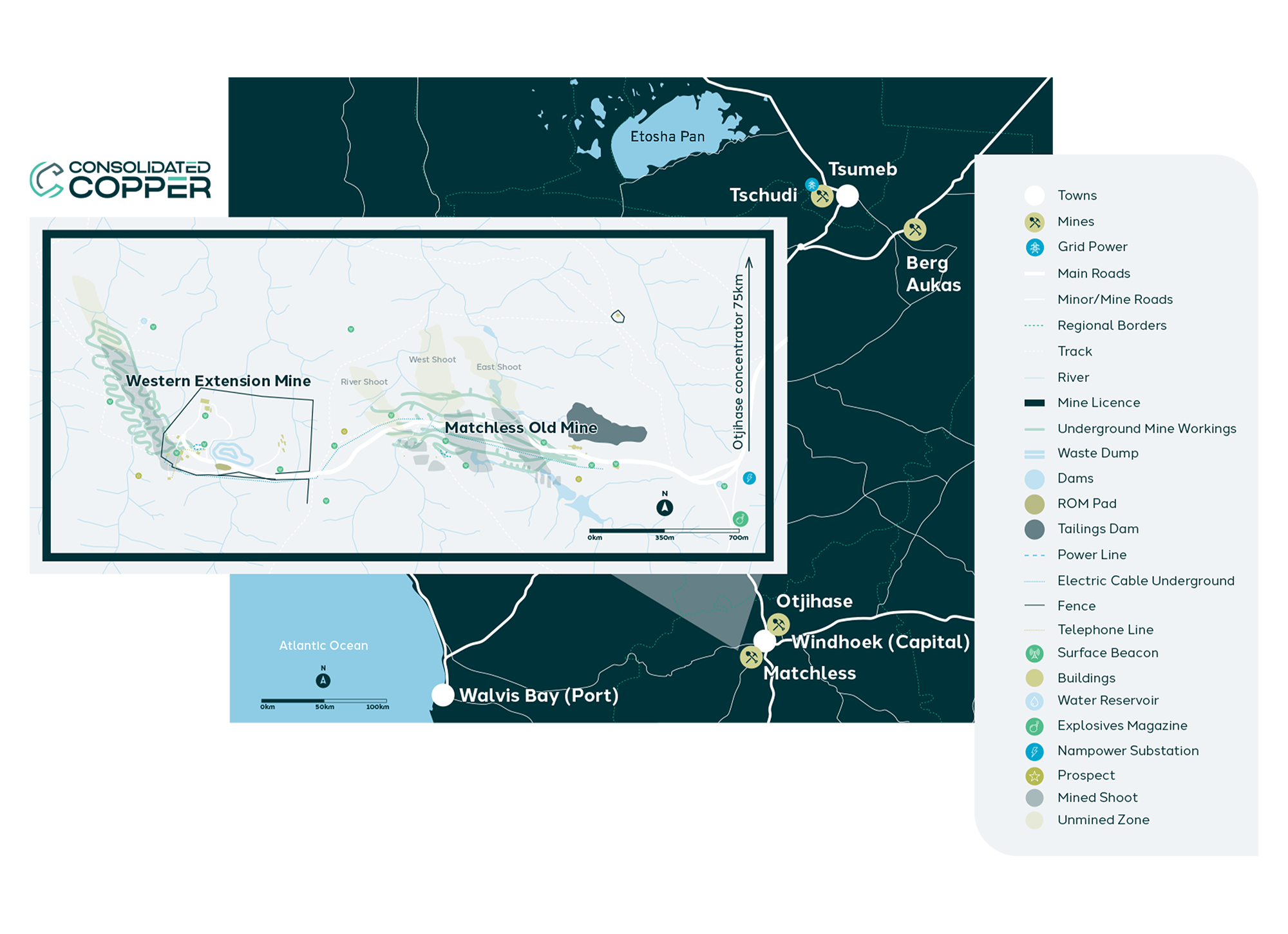
Central Operations is the collective name for Consolidated Copper Corp’s twin underground copper complexes, the Otjihase mining complex and concentrator and the Matchless mining complex, strategically located just 18km and 30km northeast and southwest respectively from Windhoek, Namibia’s capital.
Consolidated Copper Corp plans to leverage this potential by pursuing concurrent operations at both Tschudi and Central Operations.
Overview
CCC is undertaking studies into the restart of the Central Operations, inclusive of the Otjihase underground mines and concentrator and the Matchless underground mines.
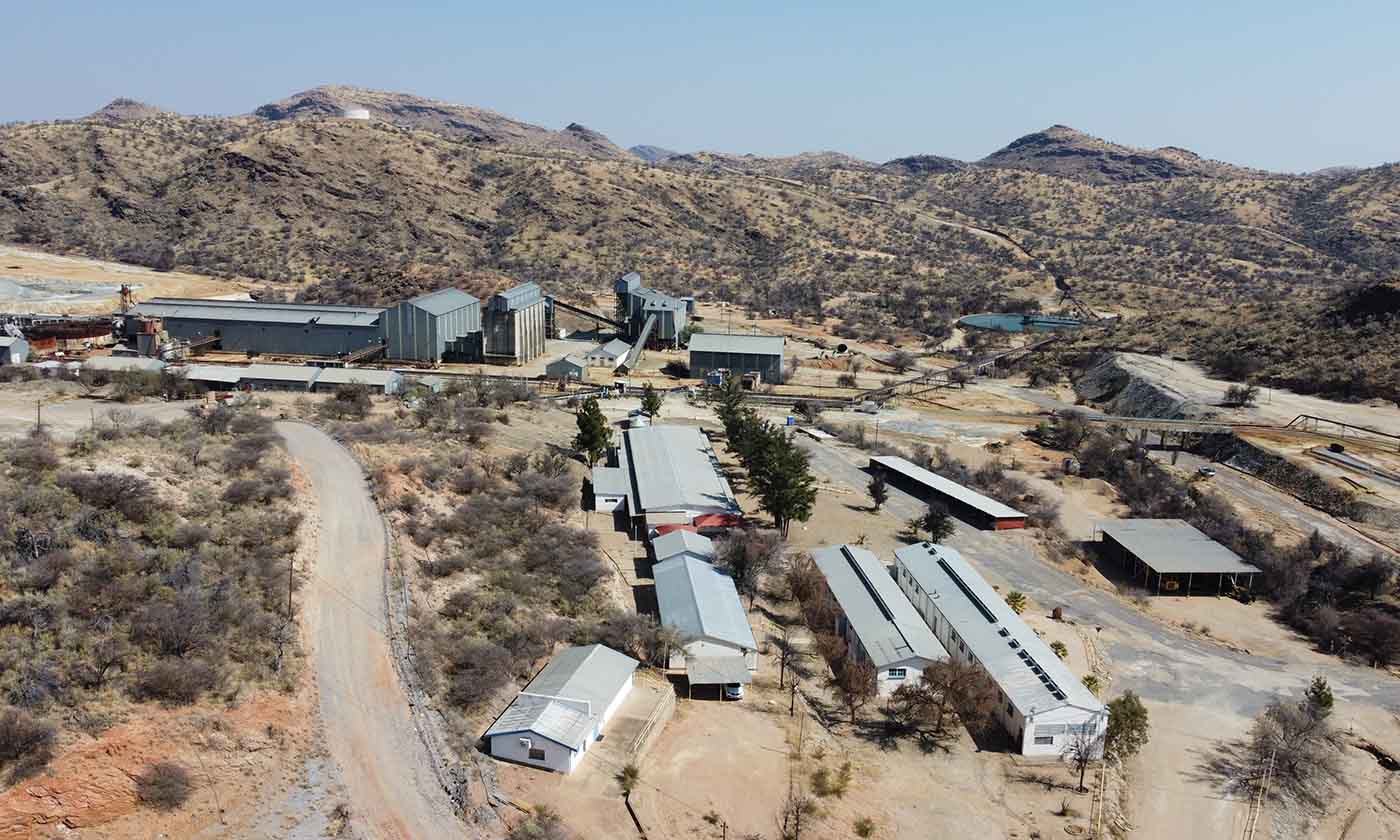
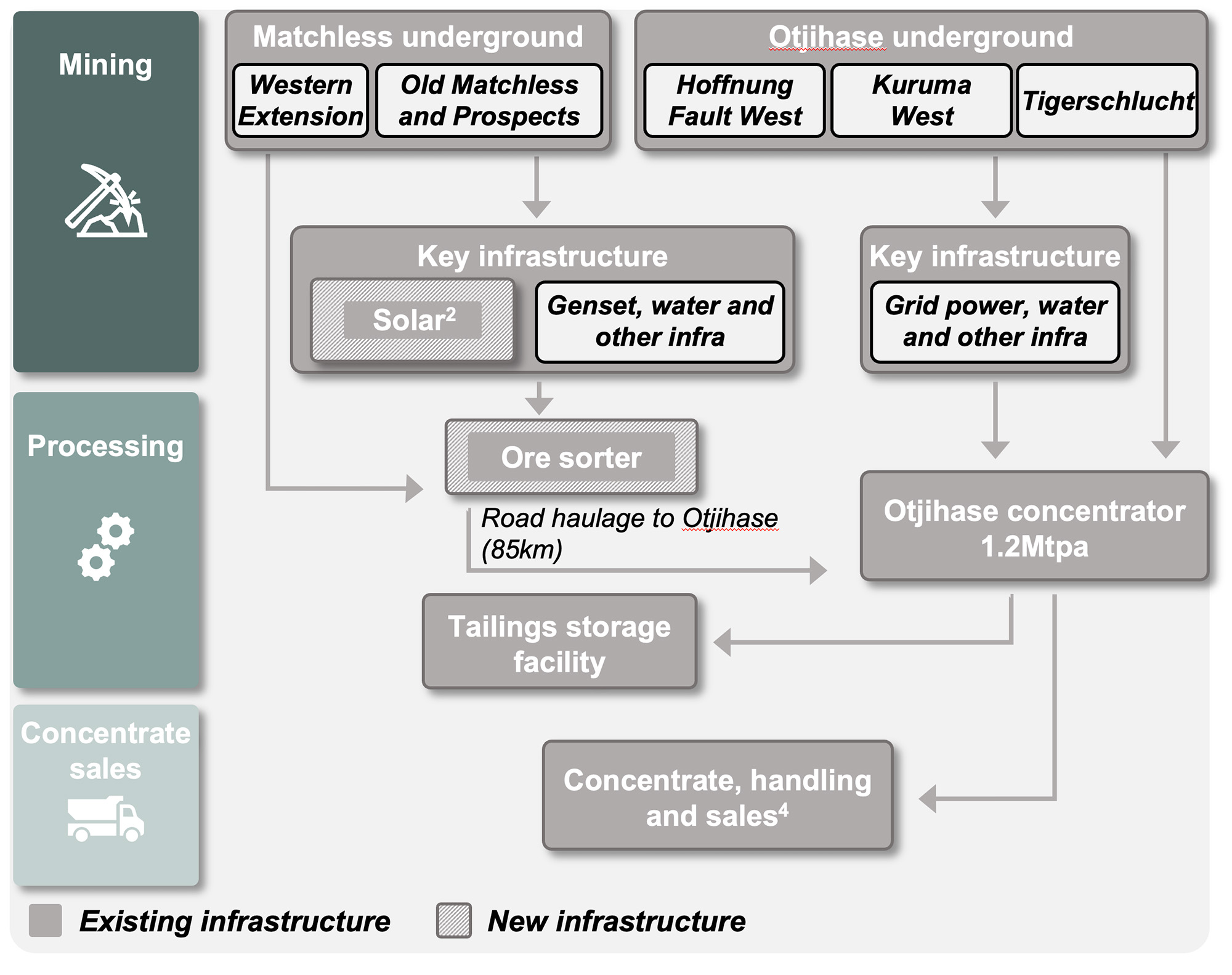
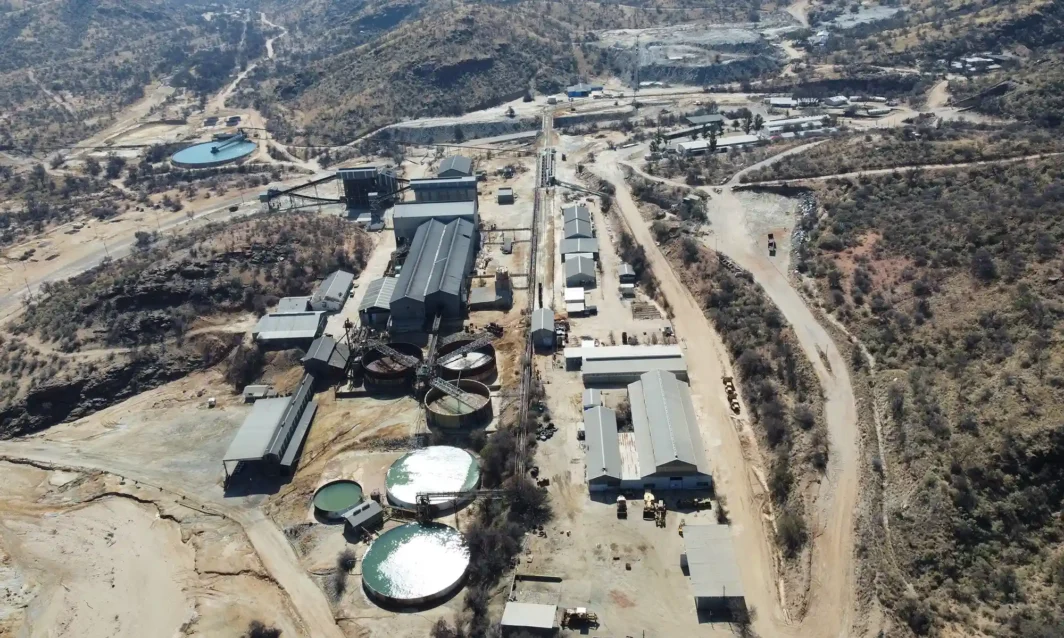
Existing infrastructure at Central Operations includes support infrastructure (power – provided by Nampower and Genset, potable water, industrial water, access roads among others), operational infrastructure (waste dump, underground pump stations, workshops, tailings dam among others) and a 1.2Mtpa concentrator at Otjihase.
A drilling campaign is currently underway at Matchless, with ongoing drilling at Matchless Western Extension, West and East Prospects and Old Matchless expected to increase resources and / or reclassify inferred into measured and indicated with c.0.5Mt of identified uplift potential against the current 1.7Mt at 1.97% Cu resource. The East, West and River shoots at Old Matchless remain open below the current resource, with potential for a further 1.2Mt at 2.0% Cu subject to exploration.
A mobile crushing and screening plant feeding an optical sorter will be installed at Matchless to dry pre-concentrate ore ahead of the 85km haul to the Otjihase concentrator, with reject material remaining on site at Matchless and screened fines trucked alongside the sorted product. Eliminating internal waste dilution from ROM ore reduces transport costs to the Otjihase concentrator by more than 30%.
Restart Highlights
- Well understood geology and substantial resource growth upside, particularly at Tigerschlucht
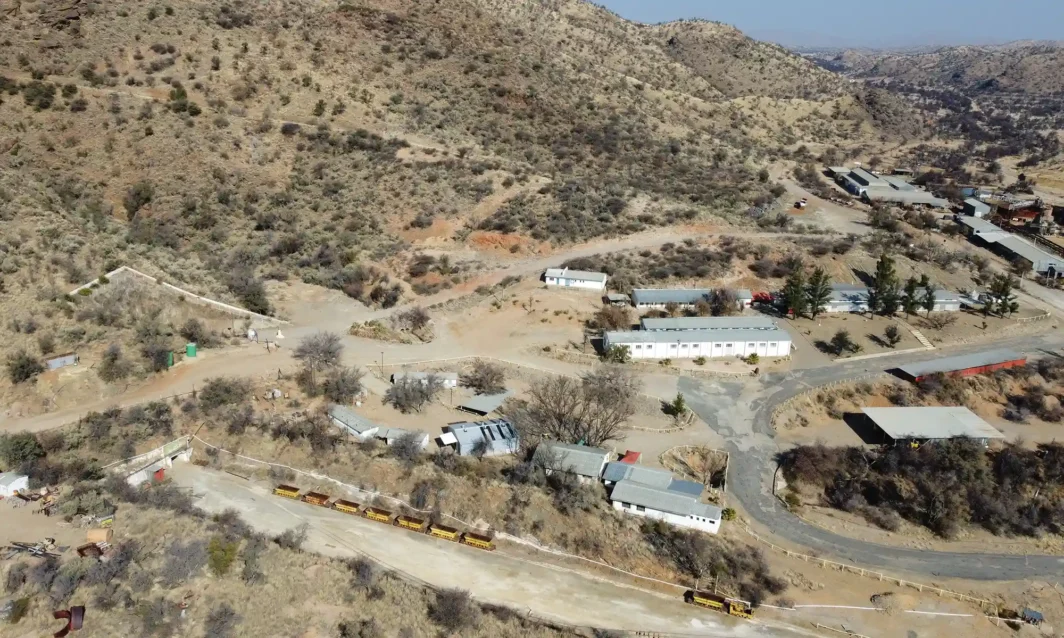
- Significant surface infrastructure, including the Otjihase concentrator, workshop areas, backfill plant, tailings dam and accommodation camps
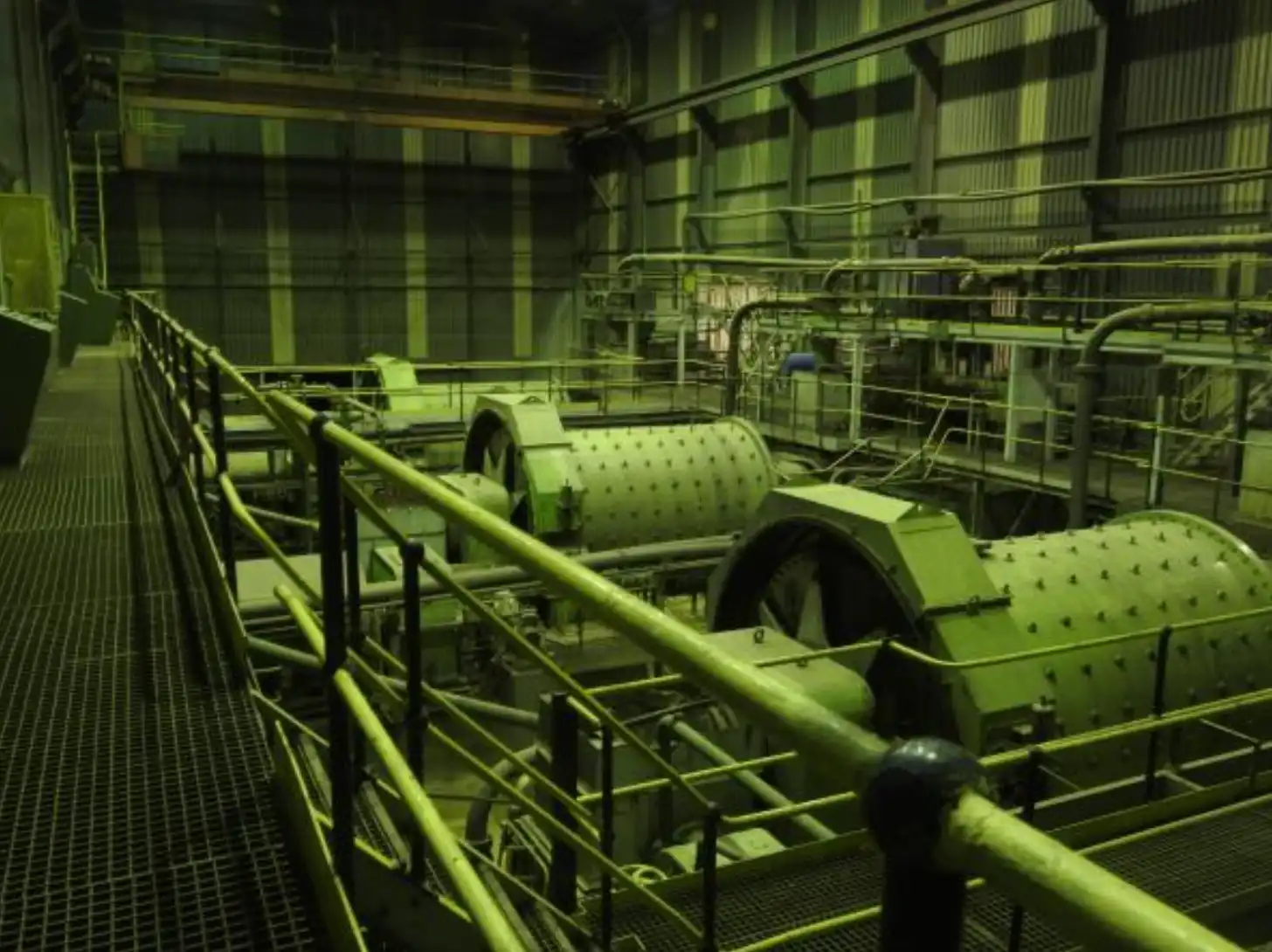
- The existing 1.2Mtpa concentrator can be refurbished in under 6 months at a cost of <$3m
- Restart plan uses cut and fill, and room and pillar underground mining at Matchless and Otjihase respectively, producing c.10kt CuEq per annum
- Historical copper concentrates at Central Operations were recognised as an attractive metal-in-concentrate, with the flotation plant sequentially producing copper concentrate and pyrite concentrate with silver being primarily contained in the copper concentrate
Location
The Central Operations mine sites are located 18km northeast for Otjihase and 30km southwest for Matchless of Namibian capital, Windhoek. Being in close proximity to the country’s capital city means that these mines have access to secure grid power and water supplies, road and/or rail transport to port and excellent local infrastructure and services.

Geology and Exploration
Central
The Central deposits lie on the Matchless Amphibolite Belt (MAB), within the Kuiseb Formation of the Damara Orogen’s Southern Zone, part of the upper Damara sequence. The Matchless Belt possesses similar geology to the Central Africa Copperbelt.
Map of Regional Geology
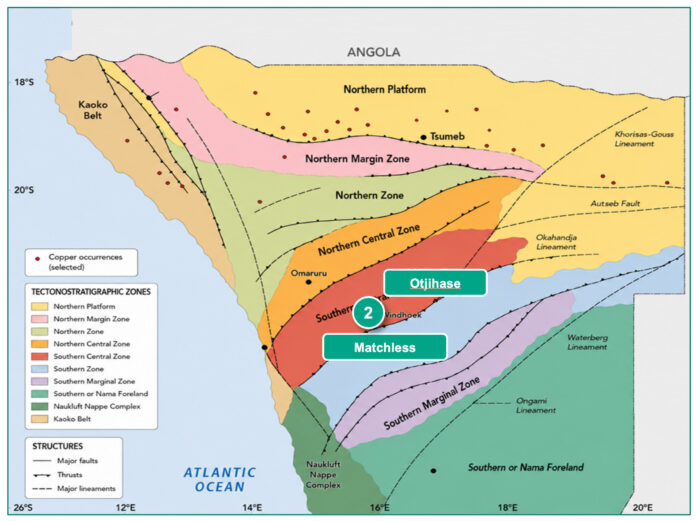
The Matchless Amphibolite Belt (MAB) is a c.350km-long, 0.5-3km-wide, NE-trending zone comprising amphibolites, schists and metagabbros hosted within the Kuiseb Formation (Khomas Subgroup, Damara Sequence) metapelites, extending from south-east of Walvis Bay through Windhoek to Steinhausen and representing metamorphosed tholeiitic basalts of submarine volcanic origin. The belt hosts 18 stratiform cupriferous-pyrite occurrences (Besshi-type VMS), formed in situ around four palaeovolcanic centres, including the Otjihase cluster (north-east), Matchless/Kupferberg (Central Operations), Gorob/Hope (south-west) and Niedersachsen. Sulphide shoots are up to 400m wide and several kilometres long, associated with magnetite quartzites (exhalative chert), and are rich in Cu-Fe-Ag-Au, with low Zn and negligible Pb. The mineralisation has undergone amphibolite-facies overprinting, with chalcopyrite locally remobilised into boudins, fractures and shears within a NE-trending, moderately NW-dipping regional fabric.
The Matchless mine features four main near-linear mineralised zones (East, West, River and Western Extension Shoots), extending over a 2.5km E-W strike length, dipping at about 30° to the north and plunging to the north-west.
At Otjihase, the mineralised zones, designated as A-Shoot and B-Shoot (collectively the Main Shoot), dip at approximately 16° north west and display copper traces and high pyrite content at surface.
Significant fault lines divide the deposit into compartments: the Otjihase Compartment, the Oblique Compartment, the Hoffnung Compartment, the Kuruma Compartment and Tigerschlucht.
The Matchless Amphibolite Belt (MAB)
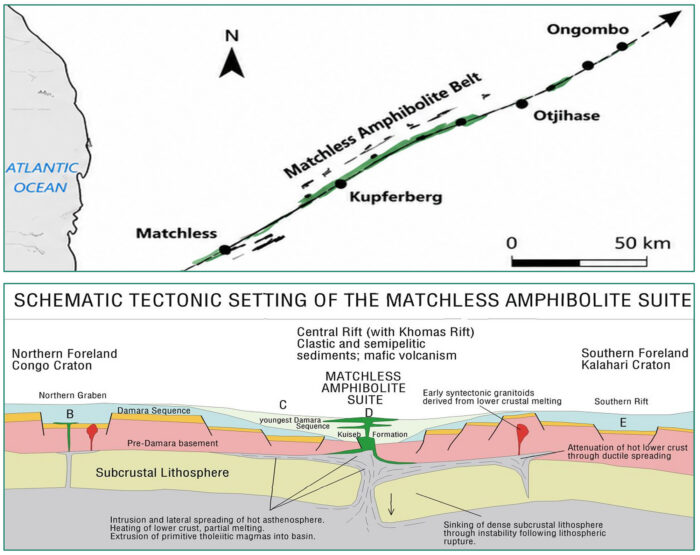
Matchless
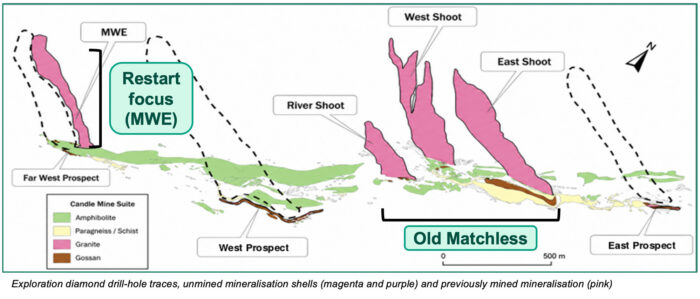
The Matchless complex is comprised of 6 shoots over 2.5 km strike (East Prospect, East / West / River, West Prospect, Western Extension). Sulphides are hosted in 6 shoots, 4 partially mined, 2 shoots to be drill-tested:
- The restart plan focuses on the Western Extension (c.1.8 km west of River)
- Old Matchless Mine is comprised of the East / West / River shoots
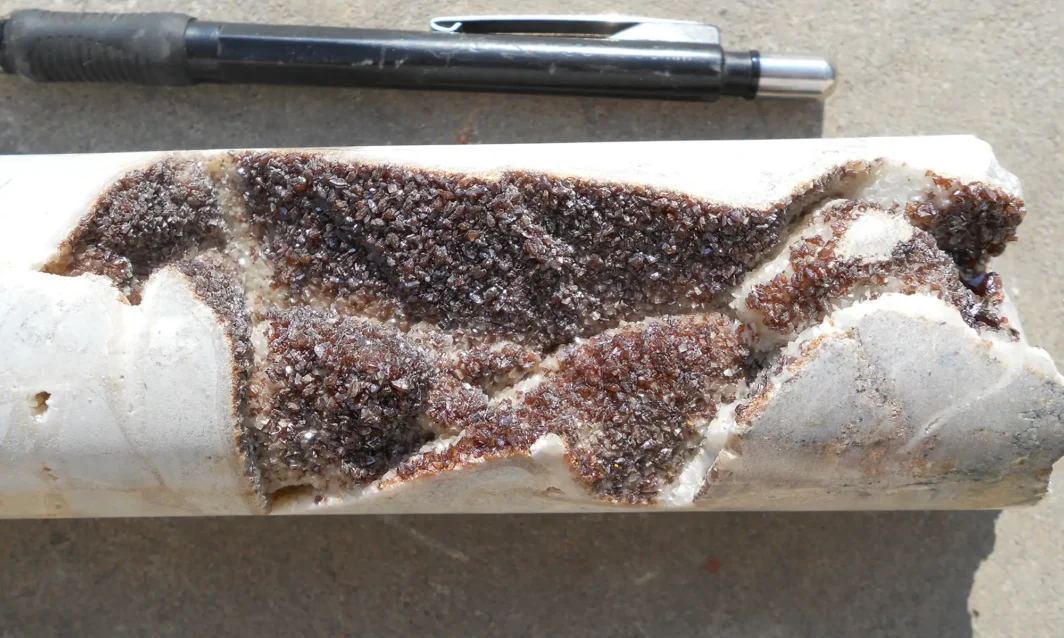
Sulphides minerals, in decreasing order of abundance include, pyrite, chalcopyrite, pyrrhotite, sphalerite, bornite and galena, with trace Ag and Au. Textures range from sparse disseminations and blebs / stringers to massive coarse-pyrite lenses several metres thick.
Mineralisation sits in sericitic quartzites, biotite-sericite schists, amphibole schists and amphibolites. Sericitic quartzite is the dominant host – silvery-white, foliated and sugary-textured, averaging c.30% pyrite by volume. Pyrite is concentrated in the sericitic quartzite; chalcopyrite enriches its upper contact and overlying schists/amphibolites, with massive chalcopyrite-pyrrhotite stringers and disseminated sphalerite in magnetite-quartzite lenses.
Matchless Mineralised Shoots
Otjihase
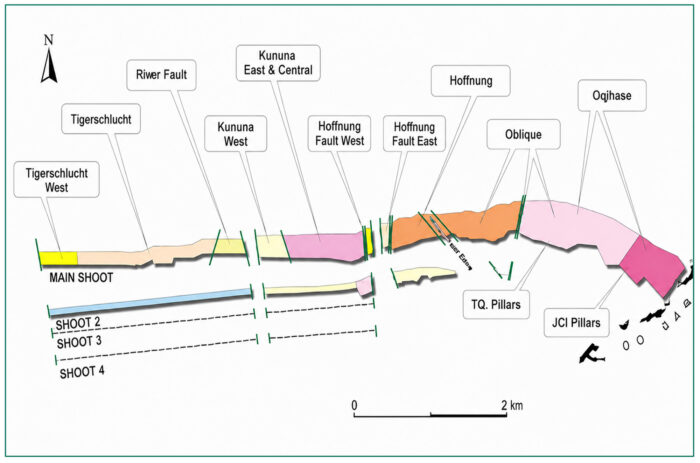
The Otjihase complex is comprised of five subparallel, westerly-plunging, spatula-shaped shoots (A, B, 2, 3, 4); Shoots A and B together form the Main Shoot but are geologically distinct. Except for Shoot B, the shoots sit at roughly the same stratigraphic level, separated by >150 m of barren-to-weakly-mineralised quartz-mica schists dipping c.16° NW. Northern margins and footwall contacts are sharp; southern margins and hanging wall contacts grade into disseminated mineralisation in the country rocks. Each shoot has a gossanous outcrop and extends >8 km down plunge, with faulting subdividing them into compartments – the Hoffnung Fault West and Kuruma West compartments being the restart-plan focus.
Ore comprises massive sulphide, magnetite quartzite and semi-massive sulphide. Pyrite dominates in abundance, chalcopyrite is the economic mineral, with minor sphalerite / pyrrhotite and negligible galena. Silver occurs mainly in chalcopyrite; gold occurs largely as native gold. A small amount of gold occurs together with silver in electrum. Rock-type and Cu-grade distribution is non-uniform – least variable along plunge and greatest across it – with material implications for resource estimation and production planning.
Otjihase comprises five subparallel mineralised zones
Restart and Planned Expansion
Matchless
Matchless cut-and-fill restart plan includes c.2.0Mt of ore in the mine plan, centred around Western Extension and Old Matchless, with existing operations also leveraging shared Otjihase processing infrastructure. Matchless Western Extension mined via the existing 5x5m trucking decline, extended from 25L down to 41L (5.4km total development). Cut-and-fill returned: 21m level spacing, 18m stope height, 3m crown pillar for improved ground control and lower dilution. Centre-of-orebody access keeps 3 levels / 6 ore faces open at any time for blending and sequencing flexibility. At Old Matchless, a study is ongoing for the dewatering project.
Crushing and optical sorting onsite to eliminate internal waste dilution from ROM ore, thereby reducing transport costs to the Otjihase concentrator by >30%. Ore is then treated at the existing Otjihase sequential flotation plant (1.2Mtpa – with c.93% Cu recovery, 23-24% concentrate and silver and gold credits). Overall, a low capex restart through sorting, the use of Otjihase concentrator and partial second-hand fleet refurbishment.
Options are available for further expansion at West Prospect and East Prospect:
West Prospect: Initial drilling in Q3 2026, development over 2028 and production by 2029
East Prospect: Drilling to start by the end of 2026 and development in 2031
Otjihase
Otjihase room-and-pillar restart plan includes c.3.0Mt of ore in the mine plan, centred around Hoffnung Fault West and Tigerschlucht, with ore processed via existing on-site infrastructure (i.e. 1.2Mtpa concentrator). Hoffnung Fault West room-and-pillar mining operations (with primary extraction up-dip to the Northern boundary and secondary extraction on retreat through partial removal of rib pillars). Minimal new development (i.e. c.80m on Shoot 2, short vent raise and access drive rehab with no new declines required). Limited infrastructure upgrade to operations (upgrade/increased capacity of pumping). Tigerschlucht development includes a twin decline system with a separate mobile-equipment decline and return airway for ventilation purposes.
Processing via on-site existing flotation plant (1.2Mtpa) with c.93% Cu recovery, 23-24% concentrate and silver and gold credits. Sales through an existing IXM offtake agreement to Walvis Bay, which has 107kt remaining concentrate to be delivered. Overall, a low capex restart from concentrator refurbishment (<$3m) and improvements on existing underground infrastructure (e.g. pump columns).
Options are available for further expansion at Kuruma West by developing through the Kuruma Central fault zones. Additional infrastructure will need to be developed to support operations, including, incremental pumping capacity, vent extension, sumps and sets / splitsets / mesh support.
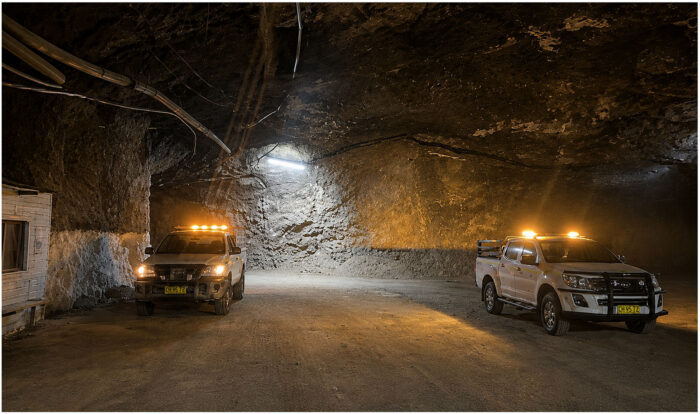
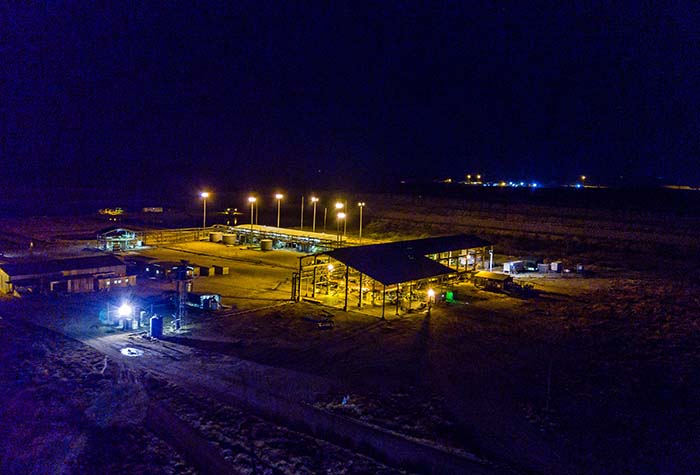
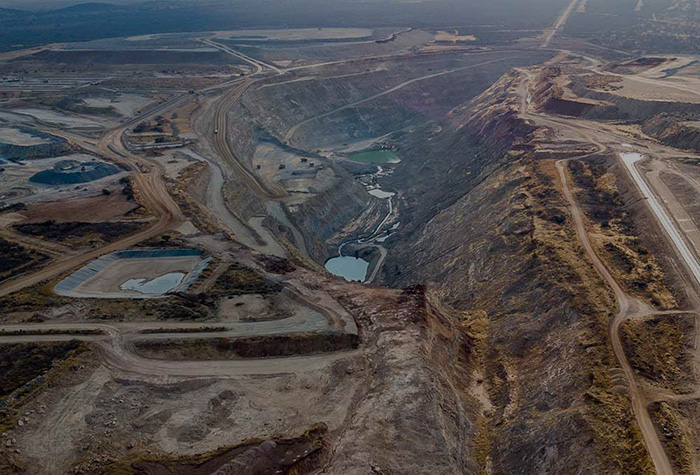
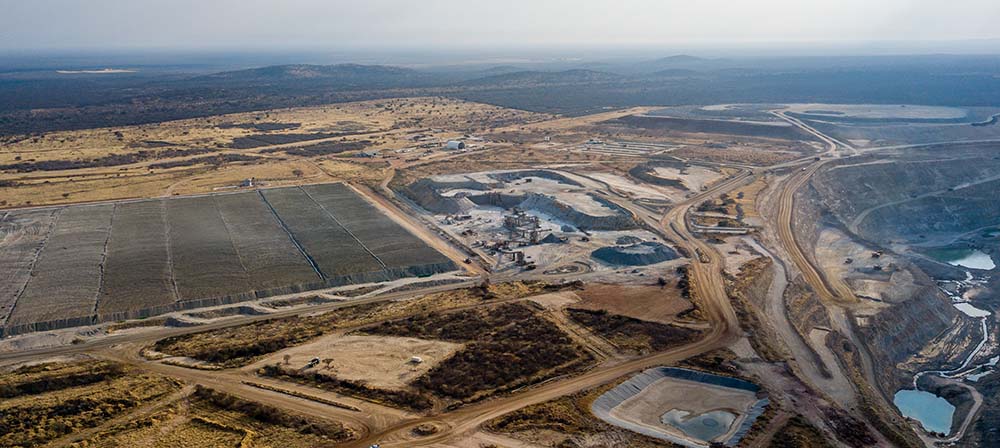
Project Gallery


Timeline
1855 – 2006: Site History
Origins of Matchless and Otjihase
Old Matchless mine was opened in 1855 by Walwich Bay Mining Company but suspended operations in 1860. It was redeveloped in 1967 and in 1970 production commenced. A circuit of copper smelters commenced smelting concentrates from the Otjihase complex in the 1970s. In the 1980s, Matchless was closed and allowed to flood.
2006 – 2018: Weatherly Era
Weatherly Supports OMPL Then CCC Steps In
Weatherly took over Ongopolo Mining and Processing Ltd and put Matchless and Otjihase on care and maintenance. In 2011, they reopened the mines and copper production restarted, but in 2015 they were again put into care and maintenance.
In 2018, a highly regarded advisor in African mining matters, John Sisay, was appointed by Weatherly administrators to review the assets. In 2022, Consolidated Copper Corp was formed with John Sisay as CEO, and CCC then acquired Matchless and Otjihase into their asset portfolio for future production.
2018 – 2023: A Time Of Transition
CCC Maintains Ongoing Care and Maintenance
Central Operations mine sites remain in care and maintenance during this time. CCC is investigating the potential to restart Central Operations and is currently developing a ten plus year mine plan as part of its feasibility studies.
2023 - Present: A New Era
Ensuring Readiness For A Restart
Consolidated Copper’s leadership team led the development of the ten plus year mine plan for Central Operations. This comprehensive plan encompasses a thorough review of existing underground operations and mining methods, including the potential for electrification. Initial drilling efforts are beginning at the western margin of the Tigerschlucht orebody, followed by further exploration across both mines. Further drilling campaigns occurred over 2026, with an updated MRE expected later in 2026. Additionally, the company is exploring the possibility of utilising its concentrator capacity for toll treatment of external ores.
Central Operations hosts significant potential for a future resource expansion:
- Matchless mine features four main near-linear mineralised zones (East, West, River and Western Extension Shoots), extending over a 2.5km E-W strike length, dipping at about 30° to the north and plunging to the north-west
- At Otjihase, the mineralised zones, designated as A-Shoot and B-Shoot (collectively the Main Shoot), dip at approximately 16° north west and display copper traces and high pyrite content at surface
- Significant fault lines divide the deposit into compartments: the Otjihase Compartment, the Oblique Compartment, the Hoffnung Compartment, the Kuruma Compartment and Tigerschlucht